200 30mm x 30mm square bases arrived just yesterday, some of which I am turning into bases, and testing my idea for the ultimate Ion Age board.
The idea as I outlined in my previous post was to glue the bases to 30mm washers available on the cheap from Wilkinsons and hopefully that will be enough to hold the individual squares to some magnetic craft sheeting which I'm still waiting for. If that fails to work I'll try adding some stronger magnets to the underside of the bases, and if that fails, I'll have to glue them down.
So either way, on to decorating the bases. The tiles for the Ion Age game are mostly concrete blocks, dumpsters, piles of rubble and futuristic vehicles. I've just got theories at the moments but I'm hoping to cast some of the concrete blocks using plaster and a rubber ice cube container. Rubble can then be produced by breaking up some of those blocks, mixing that with cat litter and throwing in bits of sprue and broken match sticks. Dumpsters should be easy enough but I'm not sure how good they'll look, so I'll look into the commercially available options, and finally the futuristic vehicles, possibly the hardest option, but I think I've found at least something:
http://www.scotiagrendel.com/Products/index.php?main_page=product_info&cPath=217_218_42&products_id=2742
I'll check back after the magnetic sheets arrive and I've done some tests.
Thanks for stopping by!
WGP

2.0. The new and improved war gaming blog.
Showing posts with label wargaming. Show all posts
Showing posts with label wargaming. Show all posts
Tuesday, 16 June 2015

Monday, 25 May 2015
Ion Age Touch Ups
So getting going on the project I posted about yesterday, I decided to touch up the figures I already had. Here's what I had already:
 A pretty basic, kind of dull paint job. And after a little while of working at it I came up with this:
 I'm migrating them from the plastic bases to washers, but aside from that I've gone with blue trousers with a yellow stripe down the outside of the leg, yellow shoulder pads, and I've added a good few highlights to the reds to really bring them out.
 I am a really big fan of that yellow stripe. I'll check back once they're all done and based, and while I'm working on that I'll think about how I can touch up the Knights.
Thanks for stopping by!
WGP


Thanks for stopping by!
WGP
Sunday, 24 May 2015
The Ion Age Firefight Project to End All Ion Age Firefight Projects
I've had a hankering to paint some Ion Age figures for a while now, and I've had my eye on some of the Legion Pioneers, which have been on my to buy list for a very long time. To go with this all a plan has been brewing to build a completely modular and three dimensional Firefight terrain set. The first step is to cover a flat and hard surface with magnetic sheeting, the second step is to mount 30mm square MDF tiles to washers, texturing the other side with sand, rubble or placing on various items of cover. The hope being that the magnetic sheeting will hold the washer tiles in place well enough for a game to be played on top. I could even make destroyed versions of certain terrain pieces to really go to town! I haven't forgotten my Retained House of Kroy and am hoping to put them into action against some Khanate scum.
So experiments will be under way in the coming weeks, but I do have to get married first and go on a honeymoon...
Thanks for stopping by!
WGP
So experiments will be under way in the coming weeks, but I do have to get married first and go on a honeymoon...
Thanks for stopping by!
WGP
Wednesday, 1 April 2015
A Basic Rundown of The Mechanics for My Solo Skirmish Wargame
Each troop type has a number of tokens, these tokens are the
same as the troop type’s stats. For example a unit with speed 4, shoot 4 and
close combat 3 will have 4 speed tokens, 4 shoot tokens and 3 close combat
tokens. The tokens for every unit are then placed in a bag or cup, and mixed
together.
One player draws a token from the bag, and the token is then
immediately resolved. For example Bill draws a speed token for the Orthodox
Sword Sisters. Each Sword Sister still in play is then allowed to move up to
4”.
MOVEMENT
A move is always 4” unless a special rule states otherwise,
this is because speed is determined by the number of tokens a troop type has,
not the distance it moves each time it performs a move action. You can apply
effects to movement such a rough terrain costing half movement etc.
SHOOTING
A hit is scored on a 4+. Each model has a choice between
firing upon its nearest enemy model in cover or its nearest enemy model in the
open, unless the nearest enemy model is in the open in which case that model
must be fired upon. Models in cover will be hit on a 5+ or a 6+, but this is
determined by the cover they are in. For models to be in cover they must be
obscured from the firing model by half or greater. When a model is hit they
lose 1 shield point.
MELEE
A melee or close combat attack is performed when two
opposing models are in base to base contact and one of their close combat
tokens are drawn. A model causes a hit on another when they roll a 4+. If a
model moves out of base to base contact the other model is allowed an immediate
free attack (meaning a token doesn’t have to be drawn) against them which hits
as normal on a 4+. When a model is hit they lose 1 shield point. If a model is
not in base contact with another they may perform a move action instead, but
this move action must be towards the nearest enemy model.
SHIELDS
If a model is hit and is reduced to 0 shield points it is
killed. When all tokens have been drawn from the bag the turn is over, all
tokens are returned to the bag, all models’ shield points are fully restored
and a new turn begins.
There will also be a number of special rules,but these have not yet been decided upon and potentially a magic system that works the same way as my previous solo game idea - there will be an additional stat for magic. When a magic token is drawn you put it to one side. When another magic token is drawn, or the turn has reached its end, you must declare what you want to do with your stored magic. Your opponent then declares an equivalent action. Pick up a number of dice equal to your stored tokens and roll them, on a single 6 your action is performed, on a roll of no 6s the opponents action is performed. You cannot combine the stored magic of multiple troop types, each troop type uses their magic individually.
Thanks for stopping by!
WGP
Sunday, 8 March 2015
Why aren't there more percentile systems?
A while ago I posted a little something about how I handle mass rolling of 2D6 without resorting to coloured pairs of dice, this was mainly due to my attempts to play Laserburn Imperial Commander. It only just dawned on me today however that you can do the exact same with 2D10 rather than 2D6, and 2D10 can be read no just as a result from 2-20, but as from 1-100. You could have the large skirmish style game (usual 40k levels of figures) based on a percentile dice system. So I suppose the question is then - is results from 1-100 necessary for a game when if you want to go really high you can get your hands on a D20?
D100 can seem a little overkill, but I suppose with that extra granularity you get granularity in your stats and real room to have characters or units improve in a campaign. Just a thought I had, having realised I haven't posted in a long while.
Thanks for stopping by!
WGP
D100 can seem a little overkill, but I suppose with that extra granularity you get granularity in your stats and real room to have characters or units improve in a campaign. Just a thought I had, having realised I haven't posted in a long while.
Thanks for stopping by!
WGP
Sunday, 15 February 2015
Old School Sci-Fi Figures
I often think about how privileged we are in the war gaming world to have almost any figure we could possibly want available online for purchase. But I wondered what you would have done a good long time ago if you wanted an army of space marines? So I set myself a little modelling challenge of coming up with a way of producing a science fiction force using only what would have been available to the gamer in the early years of the hobby.


So after a bolt of inspiration I grabbed a handful of 1/72 WW2 figures, and a box of 'map pins' and did the following:
Not sure if anyone ever did do this, but it works for me, and they do have a certain charm. Now to create an opposing force and find a rules system to use.
Thanks for stopping by!
WGP
Friday, 13 February 2015
The Elusive Tactical Retreat
I've been thinking up rules which is usually all I think about apart from Theology, and this week I've been struggling with the idea of the tactical retreat.
It seems, in my experience anyway, what the tactical retreat really only works within the campaign game. Other wise you're always working your forces down to the bone, only the mission matters regardless of the cost, which isn't at all realistic. Troops are either destroyed or hang around until their morale breaks and they flee... there may well be a point at which you pull some men back from a position a small tactical retreat if you will, but I'm talking about a force wide retreat off the table of troops that are not fleeing in fear, and for good reason. It's something that happens a lot in real wars, but again on the table top is unlikely unless your trying to save troops for a mission later on in a campaign.
So how can we replicate this on a tabletop in a stand alone game?
Kings of War game me an idea. In Kings of War there are three outcomes to a game you can win, lose or draw. The margin of the draw is quite large however, so one player can have earned more points than another, quite a few in fact, but the game still counts as a draw.
Say you're getting battered by your opponents force, and you know that very soon he'll have so many more points than you that it will be a win for him and a lose for you. What if by making that tactical retreat, you can force a draw?
Just a thought. Plus I'm thinking it's better to reward players more points for taking prisoners and less for killing people... just so we can have less blood baths and more ethical gaming (assuming you treat your prisoners well).
Thanks for stopping by!
WGP
It seems, in my experience anyway, what the tactical retreat really only works within the campaign game. Other wise you're always working your forces down to the bone, only the mission matters regardless of the cost, which isn't at all realistic. Troops are either destroyed or hang around until their morale breaks and they flee... there may well be a point at which you pull some men back from a position a small tactical retreat if you will, but I'm talking about a force wide retreat off the table of troops that are not fleeing in fear, and for good reason. It's something that happens a lot in real wars, but again on the table top is unlikely unless your trying to save troops for a mission later on in a campaign.
So how can we replicate this on a tabletop in a stand alone game?
Kings of War game me an idea. In Kings of War there are three outcomes to a game you can win, lose or draw. The margin of the draw is quite large however, so one player can have earned more points than another, quite a few in fact, but the game still counts as a draw.
Say you're getting battered by your opponents force, and you know that very soon he'll have so many more points than you that it will be a win for him and a lose for you. What if by making that tactical retreat, you can force a draw?
Just a thought. Plus I'm thinking it's better to reward players more points for taking prisoners and less for killing people... just so we can have less blood baths and more ethical gaming (assuming you treat your prisoners well).
Thanks for stopping by!
WGP
Saturday, 7 February 2015
The Colour of Paraguayan Uniforms?
So the Osprey has come through in the post and I have embarked on more serious reading regarding the Chaco War. But after a basic flick through I've got a conundrum...
The Paraguayan Infantry I have already painted were colour wise based on this image:


The Paraguayan Infantry I have already painted were colour wise based on this image:
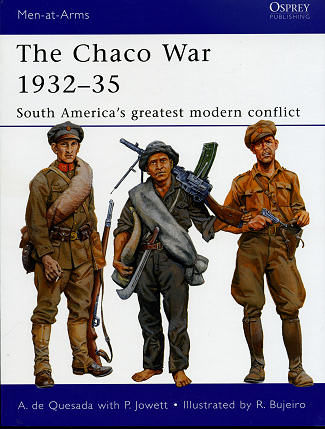
It's the front cover of the Osprey as I found it on google images, the Paraguayan Infantryman being the man in the centre (if you hadn't already guessed). One thing the Osprey has inside is lots of actual photographs of soldier during the war and a number of images of Paraguayan Infantry. One such image (not in the Osprey but which emphasises my point) is:

Now I'm not sure if it's a trick of the light or camera, or if there is a point in the Osprey I haven't yet gotten to, but the majority of the images I can find of Paraguayans would lead me to believe that their uniforms are infact, at least in the majority far lighter than the cover of the Osprey would lead you to believe. One of the few images I found to the contrary was this one:

But I would still say the uniforms are a few shades lighter than the Osprey, and there's a fair few lighter shirts and trousers dotted around. So maybe it's closer to the truth to paint my troops in a much lighter yellow-green as opposed to the olive (castellan green) I was using.
Just a thought, thanks for stopping by!
WGP
Thursday, 5 February 2015
The Chaco War Project
My wargaming 'hipsterness' has reached new heights in that I'm now planning on doing a Chaco War project... a war which has fairly little information out there in the various aisles of the internet, at least information in English. So I bought my first Osprey, and through looking at pictures on google images realised I had a few relatively useful miniatures in my 'random miniatures I bought with no intention of actually using' box. A while back I grabbed a few of EM4's civil war figures, one set of Confederates and one set of Union. Browsing google I realised while not perfect there were enough similarities between Paraguayan infantry in the Chaco war and EM4's confederates that I painted some up as such. Here's how that went:

After a layer of PVA because the plastic is more like vinyl and Nato Black from Tamiya. I also cut the bayonet of off the end of the rifle.

The base colours.

A wash of Agrax Earthshade.

Sand on the integral base.

The base was painted with Tamiya Khaki and finally the whole figure was lightly drybrushed with Ushabti Bone, a process I have heard called 'dusting'.
I'm looking at more conversions, such as turning the Union figures into Bolivian Infantry, but only time will tell on that one! I'm also looking at scratch-building some Vickers MGs so more on the Chaco War project in the future!
Thanks for stopping by!
WGP
Wednesday, 4 February 2015
When a game is obviously a game it's a problem
If you regularly have a peek at what I'm up to you'll usually see that I'm tweaking or working on rules, in fact this is probably the main way my hobby expresses itself in my day to day life. When I'm not thinking about rules I'm usually painting models and listening to podcasts, my favourite of which is Meeples and Miniatures. The reason I love this podcast so much is because, as you may have guessed already if you've ever heard the show is how in depth they go into the rules mechanics of certain games. In the Meeples and Miniatures spin-off podcast View From the Veranda the host Neil and Henry Hyde of Miniature Wargames fame were discussing the difference between 'gaming' and 'wargaming', 'gamers' and 'wargamers'. The 'wargamer' being the one more concerned with historical plausability and realism as opposed to cool mechanics, and the 'gamer' being all about the mechanics as an end in themselves rather than a means to an end. My thoughts on this distinction came to a head while watching a demo game of Bolt Action from Warlord Games on the Beasts of War youtube channel. Bolt Action has been called by many the 40k of the historical hobby, which makes a lot of sense when you consider the minds behind it, and isn't necessarily a bad thing (although I'm sure some mean it that way). Bolt Action has at it's core a mechanic to randomise unit activations. There is a central bag of dice into which is added a die per unit on both sides. When a die is drawn a unit activates the colour of the die determining which side it belongs to. I drew a grey die so the Germans activate, next I drew a green die so the Americans activated a unit, so on and so forth, with each unit only activating once each. The problem came for me when Warren noticed that since one flank on his opponents side had already activated it wasn't urgent for him to take action on that flank. I would say it provides you with a tactical choice to make, but in reality it doesn't because the correct choice is and always will be obvious, attack what hasn't yet activated to reduce its effectiveness, but that's not my main problem. My main problem is that it presents you with a 'game' scenario, not a 'historical' scenario. When has any general ever said "It's no longer pressing for me to order my men on the right flank since the enemy has already activated his units." What the mechanic does is force something to the surface that we as wargamers really shouldn't be reminded of - that model men need to be 'activated' at all. Real soldiers don't pause after they have run a certain distance, or wait their turn to shoot, and while these may be necessary evils in many cases for us as wargamers we shouldn't be reminded of such things while playing, especially when we are reminded by making a choice that was never made by a real life officer. Call it a fatal flaw in the single unit activation type game, at least one where you determine the activations to take place as opposed to randomness like in Gruntz or levels of experience like in USE ME. The goal we are striving for as rules writers or tweakers (because if you game you're one or the other) is simultaneous action, so why make a point out of being a single unit activation style game?
Thanks for stopping by!
WGP
Thanks for stopping by!
WGP
Sunday, 25 January 2015
Here's an idea for solo gaming
Grab a deck of cards with all the kings, queens and jacks removed, so you get a deck of Aces to 10s. Then take a large number of six sided dice and take ten of those and put them to one side. The deck is your game deck, and the 10 dice are your dice pool.
Set up your table with your figures and with your scenario in mind.
Declare what you want one of your figures to do and then declare a roughly equivalent action one of the enemy figures will do.
Draw a card (always draw the card after you declare the two actions, never before!), if it's red it increases your dice pool by the number on it. Aces=1. If it's black it locks a number of dice in your pool equal to it meaning you cannot use them in the roll. Pick up a number of dice you want to roll and roll them. The action you declared for your figure is performed if you roll a single 6. If no 6s are rolled then the action you declared for the enemy figure is performed. You must always roll at least 1 die, unless the black card locks all your dice in which case you automatically fail.
Return any rolled dice to the big pile, declare two new actions and then draw a card.
Repeat this process until the deck is exhausted or you complete the scenario objective.
If you haven't completed the objective by the time the deck is exhausted you automatically lose the game.
You could play the game as simply as that. You could enforce a stats system on top of it, whereby when an action is 'performed' it still needs to be rolled for. For example, I failed and so get charged by an enemy and attacked, the enemy can only move up to their move stat in inches, and will only hit me when they get there on a roll that is equal to or lower than their fight stat. You could on the other hand impose a system of special rules. For example - I declare that my warrior will strike the enemy causing a light wound on their barbarian, the equivalent is obvious, he will attack me instead and cause a light wound. I draw the card and roll. I score a 6 meaning my warrior hits the barbarian. My warrior however has the special rule 'devastate' which turns any light wounds caused into heavy wounds, so although I declared a light wound I deal a heavy wound. The enemy barbarian does not have the special rule devastate, so had I failed the roll, my warrior would only have taken a light wound.
Thoughts?
Thanks for stopping by!
WGP
Set up your table with your figures and with your scenario in mind.
Declare what you want one of your figures to do and then declare a roughly equivalent action one of the enemy figures will do.
Draw a card (always draw the card after you declare the two actions, never before!), if it's red it increases your dice pool by the number on it. Aces=1. If it's black it locks a number of dice in your pool equal to it meaning you cannot use them in the roll. Pick up a number of dice you want to roll and roll them. The action you declared for your figure is performed if you roll a single 6. If no 6s are rolled then the action you declared for the enemy figure is performed. You must always roll at least 1 die, unless the black card locks all your dice in which case you automatically fail.
Return any rolled dice to the big pile, declare two new actions and then draw a card.
Repeat this process until the deck is exhausted or you complete the scenario objective.
If you haven't completed the objective by the time the deck is exhausted you automatically lose the game.
You could play the game as simply as that. You could enforce a stats system on top of it, whereby when an action is 'performed' it still needs to be rolled for. For example, I failed and so get charged by an enemy and attacked, the enemy can only move up to their move stat in inches, and will only hit me when they get there on a roll that is equal to or lower than their fight stat. You could on the other hand impose a system of special rules. For example - I declare that my warrior will strike the enemy causing a light wound on their barbarian, the equivalent is obvious, he will attack me instead and cause a light wound. I draw the card and roll. I score a 6 meaning my warrior hits the barbarian. My warrior however has the special rule 'devastate' which turns any light wounds caused into heavy wounds, so although I declared a light wound I deal a heavy wound. The enemy barbarian does not have the special rule devastate, so had I failed the roll, my warrior would only have taken a light wound.
Thoughts?
Thanks for stopping by!
WGP
Monday, 19 January 2015
Skirmyth - The Solo Skirmish/ Light RPG: A Second Encounter
I played a quick solo game this evening using my second incarnation of the Skirmyth rules. A system with more visible stats, but still with no real need to look anything up. Characters are activated when a counter with their name on it is pulled from a cup, the counter has written on it not only the characters name but their speed and attack stats. The number of counters a character has in the cup is equal to their initiative value. Speed determines the distance a character can move in inches when their counter is drawn and attack determines the number of dice a character will roll when making attacks. They do damage equal to the number of successes they score on the dice rolled (Warriors 4+, Rangers 5+ and Mages 6+). Apart from character counters there are also joker counters in the cup. Jokers stay out of the cup until the 'end' counter is drawn but return all other counters to the cup. When the end counter is finally drawn the number of jokers determines which column on a table is rolled on to determine a random event. For example in my game, two jokers were drawn and so when the end counter was drawn I rolled a die and consulted the event table, for two jokers and a roll of a 6 there was a small earth tremor which caused both sides to take morale checks. Morale is currently an extremely simple system. When a character is killed or you are forced to take a morale check by other means pick up a die per character still alive on your side and roll them. You pass the morale check if you roll a single 4+, if you fail to roll any 4+s you fail the check and lose the game. I thought it might be too simple initially but it creates a really interesting dynamic - you don't want a small number of hugely powerful characters because you'll get less dice when making morale checks, on the other hand you don't want a huge number of weak characters because that will normally mean you have to make more morale checks. I also thought it might create unrealistic scenarios where heroes flee from much weaker foes, however should a band of heroes lose a character surely their concern is no longer the mission, but protecting and restoring that fallen character to health? So in that sense it portrays greater realism. The real strength of it however is in the fact that morale is controlled by a standard dice roll meaning you never have to look anything up. The number of dice you roll being the number of remaining characters you have!
This evening I played a simple 4 vs 5 line up and charge at each other game.
On the one side we had -
Sir Gildain - I:4, A:4, S:3, R:6, PTS:34, Warrior
Pharen Thark - I:3, A:4, S:5, R:5, PTS:32, Warrior
Terse Kolf - I:2, A:6, S:5, R:5, PTS:27, Ranger
Tannik Druze - I:2, A:8, S:3, R:5, PTS: 27, Mage
And on the other we had -
Prince Lorek - I:2, A:5, S:5, R:10, PTS:30, Warrior
Harken Drane - I:2, A:7, S:3, R:5, PTS: 25, Mage
Kel Krace - I:4, A:2, S:2, R:4, PTS: 20, Warrior
Skorth Dar - I:3, A:3, S:4, R:5, PTS: 26, Warrior
Ajen Low - I:1, A:12, S:7, R: 5, PTS: 24, Ranger
The game was supposed to be 120pts, however while writing this up I realised that Prince Lorek's force was 125 points... but considering Sir Gildain tabled him without losing a man it's not like those extra 5 points really helped.
The game played exceedingly quickly. I remember reading lots of rulebooks where games claim to be 'fast paced' but this one truly is, with a standard skirmish like this taking around 10 minutes to play. You may also notice I was intentionally trying to break the game with characters like Kel Krace and Ajen Low, Kel having a huge number of activations but being pretty weak and Ajen only a single activation but devastating when he does activate.
So what have I learned and what questions have this little playtest brought to light?
Primarily I need to decide what route I want the main focus of the game to take. At present I'm playing it much like your average skirmish game where two evenly matched albeit different forces face off, rather than a dungeon crawling, hack and slash style game with multiple enemies each far weaker than our main characters.
Secondly I need to decide how damage dealt is increased by circumstances - at the moment if your characters remaining resolve is double their targets the amount of damage they do is doubled, and tripled if triple etc. Alternatively if two characters are ganging up on another the damage dealt is doubled. I need to playtest further to see if this is too dramatic an increase and maybe adding rather than multiplying would be more appropriate. Obviously +0 if no damage is dealt, +1 if resolve is higher, +2 if double, +3 if triple, and +1 per additional character in the combat.
Thirdly I need to develop the actual solo AI mechanics.
Fouthly I need to develop scenarios to make the game more interesting/ narrative.
Thanks for stopping by!
WGP
This evening I played a simple 4 vs 5 line up and charge at each other game.
On the one side we had -
Sir Gildain - I:4, A:4, S:3, R:6, PTS:34, Warrior
Pharen Thark - I:3, A:4, S:5, R:5, PTS:32, Warrior
Terse Kolf - I:2, A:6, S:5, R:5, PTS:27, Ranger
Tannik Druze - I:2, A:8, S:3, R:5, PTS: 27, Mage
And on the other we had -
Prince Lorek - I:2, A:5, S:5, R:10, PTS:30, Warrior
Harken Drane - I:2, A:7, S:3, R:5, PTS: 25, Mage
Kel Krace - I:4, A:2, S:2, R:4, PTS: 20, Warrior
Skorth Dar - I:3, A:3, S:4, R:5, PTS: 26, Warrior
Ajen Low - I:1, A:12, S:7, R: 5, PTS: 24, Ranger
The game was supposed to be 120pts, however while writing this up I realised that Prince Lorek's force was 125 points... but considering Sir Gildain tabled him without losing a man it's not like those extra 5 points really helped.
The game played exceedingly quickly. I remember reading lots of rulebooks where games claim to be 'fast paced' but this one truly is, with a standard skirmish like this taking around 10 minutes to play. You may also notice I was intentionally trying to break the game with characters like Kel Krace and Ajen Low, Kel having a huge number of activations but being pretty weak and Ajen only a single activation but devastating when he does activate.
So what have I learned and what questions have this little playtest brought to light?
Primarily I need to decide what route I want the main focus of the game to take. At present I'm playing it much like your average skirmish game where two evenly matched albeit different forces face off, rather than a dungeon crawling, hack and slash style game with multiple enemies each far weaker than our main characters.
Secondly I need to decide how damage dealt is increased by circumstances - at the moment if your characters remaining resolve is double their targets the amount of damage they do is doubled, and tripled if triple etc. Alternatively if two characters are ganging up on another the damage dealt is doubled. I need to playtest further to see if this is too dramatic an increase and maybe adding rather than multiplying would be more appropriate. Obviously +0 if no damage is dealt, +1 if resolve is higher, +2 if double, +3 if triple, and +1 per additional character in the combat.
Thirdly I need to develop the actual solo AI mechanics.
Fouthly I need to develop scenarios to make the game more interesting/ narrative.
Thanks for stopping by!
WGP
Tuesday, 13 January 2015
Scurge of the Solo Wargamer Part 2 of N: Solo Skirmyth (Skirmish-Myth geddit?) First Playtest
Reflecting on my previous post in this series I drew up a simple set of rules. The goal of which was to eliminate the need for statlines, which while they exist are effectively invisible. My first attempt works as follows, a character has 3 stats, Attack, Speed and Resolve. The Resolve of a character is equal to their level, and the Attack and Speed when totalled are equal to their level. My hero, Sir Gildain Knight of the Green Sword, has Attack 7, Speed 3, Resolve 10 and is level 10, simple enough. Resolve is the number of hit points a character has, once Sir Gildain has taken 10 points of damage he is out of the game. Speed and Attack are converted into cards that go in the game deck. Sir Gildain gets 7 attack cards and 3 speed cards (or alternatively counters in a cup). When a speed card is drawn, Sir Gildain gets to move D6". When an attack card is drawn Sir Gildain gets to make an attack, or if he can't he can save the card for later.
Battles are fought between equally effective forces, just use their levels like a points system. For example -
The Heroes

Sir Gildain - Attack 7, Speed 3, Resolve 10, Level 10. Type - Warrior

Kora the Barbarian - Attack 5, Speed 5, Resolve 10, Level 10. Type - Warrior
Total Level - 20
The Orc Bandits (or Celts painted green)

Krug the Shaman - Attack 3, Speed 2, Resolve 5, Level 5. Type - Mage.
Boleg the Archer - Attack 4, Speed 1, Resolve 5, Level 5. Type - Ranger.
Bazgar the Berserker - Attack 0, Speed 5, Resolve 5, Level 5. Type - Warrior.
Agaz the Axe Orc - Attack 3, Speed 2, Resolve 5, Level 5. Type - Warrior.
Total Level - 20.
You'll notice each character has a type. Types are as follows:
Warrior - No ranged ability, hits in melee on a 4+.
Ranger - 5+ to hit at range or in melee.
Mage - 6+ to hit at range or in melee, magic user.
Once you have all your cards shuffle them with a single joker included, and draw the top card to begin playing. Here's a little playtest battle report, I'm not adding much flavour but simply listing the cards drawn at what happened so you get an idea of how things work -
The two sides face off against each other, on a rather barren plain...

The Agaz charges Kora while the archer fires at her and and misses.
Sir Gildain saves an attack.
The archer fires at Kora again and rolls a 1, missing by miles.


The card mechanic works perfectly, the only chore being having to make the cards. I think in the end I will opt for counters drawn from a cup, but until then it works fine. What I like most about the card mechanic is it builds in character quality without any additional characteristics. The higher level a character, the more cards they have, the more likely they are to get cards before the joker is drawn! This is why opted for a card per point of stat rather than the stat on a single card. Sure it means more cards or counters, but it gives you something extra for your troubles. Something strange I did notice was that I no longer looked at characters as a line of stats because I couldn't see their stats, but I felt the characters. That may seem like a strange sentence and it is, because I've never experienced that in a game.
Although the game doesn't currently have a solo mechanic built in I have left space for it, by which I mean that when a card is drawn it's a really simple decision for an AI to make since your decisions are so restricted. For a speed card warriors are most likely to charge the nearest enemy, and rangers and mages are most likely going to use them to keep their distance. AI controlled Rangers and warriors will always use their attack cards as they appear, saving them only if they can't use them, since mathematically it makes no difference. Mages will be more likely to hold on to their attack cards so they can cast spells but I devised a simple system for that while playing. The magic system which is 3 lines in the current rules allows any spell you can imagine and is fully reversible, meaning you will come up with horribly cunning spells for the AI to cast on your own characters more on that another time.
The rules even have room for a full leveling up system, which in it's first iteration is as follows -
1 XP per enemy character your character killed.
1 XP per objective achieved by your character.
Pick up an number of D6s equal to the total XP gathered by your character and roll them.
The character levels up 1 level per 4+ rolled.
The new levels can be used on either attack or defence in any way you choose!
For example here's what I actually rolled after the fight -
Kora killed 2 enemies and so gets 2 dice, she rolled a 5 and a 6 taking her up to level 12. She opts to put 1 level into speed and the other into attack.
Sir Gildain killed 1 enemy, and luckily rolls a 4. He opts to put it into speed (for obvious reasons).
The leveling up system fits because of the card system, it's easy to include any number of stats because you can add any number of cards to the deck, you're not limited by the dice used, a stat can be more than 1-6 or 1-20 or even, if you're crazy 1-100.
That was a long one, but thanks for sticking with it and thanks for stopping by!
WGP
 |
| Here's Sir Gildain and his cards, I just used playing cards with labels stuck to them. The top row say 'Sir Gildain Attack', the bottom row say 'Sir Gildain Speed' (maybe 'run' would make more sense). |
The Heroes
Sir Gildain - Attack 7, Speed 3, Resolve 10, Level 10. Type - Warrior
Kora the Barbarian - Attack 5, Speed 5, Resolve 10, Level 10. Type - Warrior
Total Level - 20
The Orc Bandits (or Celts painted green)
Krug the Shaman - Attack 3, Speed 2, Resolve 5, Level 5. Type - Mage.
Boleg the Archer - Attack 4, Speed 1, Resolve 5, Level 5. Type - Ranger.
Bazgar the Berserker - Attack 0, Speed 5, Resolve 5, Level 5. Type - Warrior.
Agaz the Axe Orc - Attack 3, Speed 2, Resolve 5, Level 5. Type - Warrior.
Total Level - 20.
You'll notice each character has a type. Types are as follows:
Warrior - No ranged ability, hits in melee on a 4+.
Ranger - 5+ to hit at range or in melee.
Mage - 6+ to hit at range or in melee, magic user.
Once you have all your cards shuffle them with a single joker included, and draw the top card to begin playing. Here's a little playtest battle report, I'm not adding much flavour but simply listing the cards drawn at what happened so you get an idea of how things work -
The two sides face off against each other, on a rather barren plain...
A speed card is drawn for Kora and she charges 6" forwards, then the same is drawn again, she rolls a 4 but opts to only move 2", so she doesn't get too far ahead of her companion.
The Krug the shaman draws an attack card and saves it, Agaz draws 2 attack cards and also opts to save them.
Sir Gildain draws 1 attack and saves it. He then draws a speed, rolls a 1, and steps forward. He then draws 4 successive attack cards and opts to save them all.
The Orc Berserker Bazgar draws a speed card and charges 5" towards Kora. The Shaman draws another attack and saves it.
Then the joker is drawn, returning all saved and used cards to the deck, it is shuffled and play begins again.
 |
| After the first bout of cards, the two forces are nearing each other, who will get first blood? |
Sir Gildain saves an attack.
The archer fires at Kora again and rolls a 1, missing by miles.
Sir Gildain saves another attack.
The Orc shaman saves an attack and then runs up behind Agaz the axe Orc for protection. Agaz saves an attack.
Kora saves 2 attacks.
The archer fires at Kora again and misses, Boleg needs to get to the firing range more often!
Kora saves another attack.
Sir Gildain saves 4 successive attacks.
Kora saves another.
Kora draws a speed card and charges Agaz, if she makes it into base to base she'll get a free attack, and can use her other saved cards in the attack too! She makes it the distance and uses her speed card and all 4 attack cards together getting her a total of 5 attack dice. She could opt to go all out, meaning she rolls 1D6 and on a 4+ does maximum damage and on a 1-3 does no damage, or she can roll 1D6 for each card.
 |
| Here we are, with cards and dice before the roll! |
 |
| And there's the roll, a devastating one! |
Kora does damage for every 4+ rolled because she is a warrior type. Damage would normally be 1 point per successful die, however since Kora's level is double that of the character she is attacking, she does 2 damage per successful die. Had Sir Gildain been in base contact with the Orc too, she would have done 1 extra damage per successful die. But as it stands with 4 successes, and 2 damage per success, she does a total of 8 damage. The Orcs resolve of 5 is no match and he is killed. Kora immediately draws a speed card and charges after the shaman but comes just short.
Bazgar the berserker draws a speed card but only charges 1" towards Kora... maybe he's afraid?
Sir Gildain draws 2 successive speed cards and manages 8 inches of movement.
Bazgar draws another speed card and makes it into contact with Kora, but only rolls a 2 when using his free attack failing to damage her.
Boleg the archer draws an attack card, with Kora in contact with Bazgar he cannot shoot her, so he opts to attack the rather slow, Sir Gildain. He manages a 5 and does 1 point of damage.
Kora draws an attack card, rolls a 6 and slams Bazgar for 2 damage.
The Joker is drawn.
 |
| After the second joker, Sir Gildain is still slowly moving forwards under fire while Kora faces off against the berserker. |
The Orc berserker tired of fighting Kora attempts a charge on Sir Gildain, he makes it in but rolls a 1 on his attack, his poorly maintained axe bounces off of the Knight's pristine armour. Boleg takes a shot at the now exposed Kora and fails to hit.
Kora charges the shaman and fails in her attack, she then wheels round and charges Bazgar but misses him too. Sir Gildain opts to save his attack card. Kora then attacks the berserker and misses.
Sir Gildain attacks using his saved card also, he chooses not to go all out, needing only a single success to score enough damage to kill the berserker, he rolls a double 2, failing on both dice and doing nothing. He then draws a speed card which he opts to ignore.
Kora bounces off of the berserker, leaving him in Sir Gildain's hands and again charges the shaman, but again she misses.
Boleg saves his attack card, since both his targets are in melee combat with his friends. The shaman opts to back off from Kora giving the archer something to shoot at, and luckily for him, forcing Kora to save the attack card she draws next.
Boleg shoots at Kora, using both his attack cards, and scores 1 hit resulting in 1 damage.
Kora saves another attack card and Sir Gildain saves another 2.
The shaman saves an attack too, but then the joker is drawn.
Bazgar charges Kora and manages 1 damage. The shaman saves an attack card.
Sir Gildain saves an attack card and then draws a speed, enabling him to attack Bazgar with two dice!
He rolls a 2 and a 6, scoring him 3 points of damage (2 for being double the level of Bazgar and an extra one since Bazgar is also in contact with Kora), the berserker is killed. Kora then charges the archer and the shaman and misses both free attacks,
Boleg the archer saves an attack card.
Sir Gildain saves two attack cards.
Boleg draws another attack and uses his saved card too, he rolls a 5 and a 2, scoring 1 point of damage on Kora.
Krug the shaman draws another attack card and opts to cast a spell, if he succeeds he will do 5 damage to Sir Gildain, if he fails to cast the spell will backfire doing 5 damage to himself. He rolls a 4 and two 2s, with no successes (6+), the spell backfires and he is killed.
To speed things up, Kora and Sir Gildain then chase the archer down and finish the Orcs off by killing him.
 |
| I'm using D10s to keep track of resolve. If you use the dice to keep track of remaining hit points rather than damage done it means you only have to look up a stat the first time a character is damaged. |
POST PLAYTEST THOUGHTS...
The game as it stands plays incredibly quickly, although to speed things up I do want to develop a morale system games where you fight to the last man often turn into a boring, going through the motions type game rather than being interesting or dynamic towards their latter half. I also noticed the importance of speed over attack. Kora although her attack was lower managed to kill 2 Orcs to Sir Gildain's 1 who spent most of his time playing catch-up (maybe his armour was too heavy). This isn't a problem with the balance of speed vs attack, it just means that Sir Gildain has to be played in a certain way. He may take a while to get to the fight, but once he's there, he's pretty devastating.
Although the game doesn't currently have a solo mechanic built in I have left space for it, by which I mean that when a card is drawn it's a really simple decision for an AI to make since your decisions are so restricted. For a speed card warriors are most likely to charge the nearest enemy, and rangers and mages are most likely going to use them to keep their distance. AI controlled Rangers and warriors will always use their attack cards as they appear, saving them only if they can't use them, since mathematically it makes no difference. Mages will be more likely to hold on to their attack cards so they can cast spells but I devised a simple system for that while playing. The magic system which is 3 lines in the current rules allows any spell you can imagine and is fully reversible, meaning you will come up with horribly cunning spells for the AI to cast on your own characters more on that another time.
The rules even have room for a full leveling up system, which in it's first iteration is as follows -
1 XP per enemy character your character killed.
1 XP per objective achieved by your character.
Pick up an number of D6s equal to the total XP gathered by your character and roll them.
The character levels up 1 level per 4+ rolled.
The new levels can be used on either attack or defence in any way you choose!
For example here's what I actually rolled after the fight -
Kora killed 2 enemies and so gets 2 dice, she rolled a 5 and a 6 taking her up to level 12. She opts to put 1 level into speed and the other into attack.
Sir Gildain killed 1 enemy, and luckily rolls a 4. He opts to put it into speed (for obvious reasons).
The leveling up system fits because of the card system, it's easy to include any number of stats because you can add any number of cards to the deck, you're not limited by the dice used, a stat can be more than 1-6 or 1-20 or even, if you're crazy 1-100.
That was a long one, but thanks for sticking with it and thanks for stopping by!
WGP
Monday, 12 January 2015
Baron Ace!

Thanks for stopping by!
WGP
Wednesday, 7 January 2015
Scurge of the Solo Wargamer - Stat Lines Part 1 of N
Playing Solo wargames can be fun, the only problem is that most rulesets are not designed for solo gaming, and those that have a solo option to play often have their solo elements tacked on to a two player ruleset, there aren't really any wargames I know of that were built as a solo experience from the ground up.
So what's the main problem when it comes to solo gaming?
In my experience it's looking up statlines. I'm happy to play both sides when there's no decent engine to run an AI opponent the only problem is you don't have two minds to remember statlines. This creates a constant flicking from game to army list or game to the more convenient but still tedious unit card. The goal then is to create a game that either has no statlines - every body hits on a 4+, or whereby the stats are there but invisible. How is that possible?
I've wondered about using a card driven system. Where each unit has a card for each stat - move, shoot, melee etc. And when the card is drawn the unit can choose to act upon the card or save the card. When the unit acts upon the card the card has the stat written on it - '5+' for example - roll your D6, no need to look it up. The problem comes with armour, or defence values, because as 'passive' stats a character wouldn't have the card in the deck. What would you do if you drew your characters 'armour' card? Nothing, but maybe save it for an attack... and then if your character hadn't drawn their armour card would they die instantly from an attack? Another idea I had was to write the defence value of the character on the base, but that can mess with the aesthetics of a game, and annoyingly practically excludes a character improvement system... unless you're willing to keep painting over and painting new numbers on bases. Hit points then seem a likely system. A higher defence character simply has more hit points. This works well enough... but does have the added drawback of the need to keep track of hit points, which for me normally means dice cluttering up the play area.
Is there an easy solution? Is this even a problem, or is it just me? Stay tuned as I mull this one over and come back with a part 2.
So what's the main problem when it comes to solo gaming?
In my experience it's looking up statlines. I'm happy to play both sides when there's no decent engine to run an AI opponent the only problem is you don't have two minds to remember statlines. This creates a constant flicking from game to army list or game to the more convenient but still tedious unit card. The goal then is to create a game that either has no statlines - every body hits on a 4+, or whereby the stats are there but invisible. How is that possible?
I've wondered about using a card driven system. Where each unit has a card for each stat - move, shoot, melee etc. And when the card is drawn the unit can choose to act upon the card or save the card. When the unit acts upon the card the card has the stat written on it - '5+' for example - roll your D6, no need to look it up. The problem comes with armour, or defence values, because as 'passive' stats a character wouldn't have the card in the deck. What would you do if you drew your characters 'armour' card? Nothing, but maybe save it for an attack... and then if your character hadn't drawn their armour card would they die instantly from an attack? Another idea I had was to write the defence value of the character on the base, but that can mess with the aesthetics of a game, and annoyingly practically excludes a character improvement system... unless you're willing to keep painting over and painting new numbers on bases. Hit points then seem a likely system. A higher defence character simply has more hit points. This works well enough... but does have the added drawback of the need to keep track of hit points, which for me normally means dice cluttering up the play area.
Is there an easy solution? Is this even a problem, or is it just me? Stay tuned as I mull this one over and come back with a part 2.
Friday, 26 December 2014
Making the most of cheap toy soldiers - Different schemes make different men!
The following 3 guys are from a bag of toy soldiers currently on sale in poundland, the reason I bought a large number of them is because, unlike most cheap toy soldiers they are pretty near heroic 28mm scale! The particular figure I'm using here is by far the best of the lot, and I wanted to test to see how different paint schemes could hide the fact that all 3 are the same model.
So from left to right we have: a member of a local militia, an officer of the NAPD which I think stands for National Police Department, and last of all a zombie solider.


The paint jobs were very quickly done, although not 100% finished in the pictures. The zombie was the fastest as you could probably guess and the militia member took the longest.
I've found that because the figures in bags of cheap toy soldiers are so generically military, that they can be painted with almost any scheme and it looks as the figure was intended to be. A good example is the NAPD officer's ballistic vest, and his balaclava which are details that were simply painted on.
All three models are for use in a skirmish game/rpg I'm working on set in a post-societal collapse of America which was possibly caused by aliens. Each figure represents one of the main factions in the game, the militias, the police, a private army of reanimated corpses. There'll also be a mutant force, a sewer scum force and the plain old army force so look out for this same figure kitted out for each of those, with the mutant having a small amout of work done with milliput. Oh and the aliens which are currently under construction and do not use the cheap toy soldiers, but use something equally as cheap!
As always I hope you had a good Christmas, and thanks for stopping by!
WGP
Tuesday, 18 November 2014
Super Toy Soldier Squad Alpha Rules
Each player has 5-10 miniatures, each miniature is given a command rating and a training level (conscript, regular and elite). One miniature on each side must have a greater command rating than all the rest on their own side, this is the leader.
At the beginning of the game both players roll off to determine who deploys first.
Each player deploys 1 miniature in turn anywhere on the table provided the miniature placed is not within LOS of any enemy miniature already deployed on the table.
Both players roll off again, this time adding the command rating of their leader, the winner gains the initiative for the turn.
Players pick up 1 die per miniature under their command (including the leader). Both players roll their dice. Dice are then attributed to miniatures with the player without the initiative placing their dice first.
Once all dice are attributed play begins.
Starting with all miniatures with a 1 attributed to them, the player with the initiative moves or shoots with their miniatures before the player without the initiative does so. Play then passes onto miniatures with a 2 attributed to them and so on up to 6.
When a miniature is activated it can either move or shoot.
Pick up 1 die for a conscript, 2 for a regular and 3 for an elite.
In order to perform the action roll the number of dice for your miniatures training level and you perform the action if you roll equal to or under the number on the die attributed to the miniature.
Any miniature activating at step 6 still fails on rolls of 6.
For example: An elite is activated at step 2 and chooses a shoot action, they pick up three dice and roll them, they succeed and hit the target if they manage to roll a 2 or less on any of their dice.
MOVING - If you succeed the miniature can move up to 4".
SHOOTING - Declare which miniature your miniature is firing on. If you succeed the miniature is hit. The miniature hit gets a saving roll if they are in cover from the perspective of the firing miniature - 3+ for cover from fire and 5+ for cover from view.
MELEE COMBAT - If your miniature moves into base contact with an enemy miniature they are allowed a free melee attack against the enemy miniature. If they are already in base contact with an enemy miniature they must perform a melee attack and can perform no other action until the other miniature is killed. Miniatures in melee combat can be fired at, but when the shot misses the attack is scored on the miniature in the melee not declared as the target. When a success is scored in melee combat the miniature hit is automatically killed.
Once step 6 is completed players roll for initiative again, roll and attribute dice again, and a new game turn begins at step 1.
MORALE - When a miniature is killed in combat it is replaced with a casualty figure. Casualty figures cannot be activated and the die for them is not rolled when rolling and attributing dice. For each casualty figure your side has the command rating of their leader is reduced by 1. When their command rating is reduced to a negative number the number counts as a modifier to the value needed to roll when activating your miniatures.
For example a side has taken 5 casualties and their leader has a command rating of 4. When rolling for initiative the leader gets a -1 modifier to their die roll. When a miniature on their side is activated at step 2 you need to roll a 1 or less instead of a 2 or less.
Miniatures will always activate on a roll of 1 regardless of the morale modifier.
At the beginning of the game both players roll off to determine who deploys first.
Each player deploys 1 miniature in turn anywhere on the table provided the miniature placed is not within LOS of any enemy miniature already deployed on the table.
Both players roll off again, this time adding the command rating of their leader, the winner gains the initiative for the turn.
Players pick up 1 die per miniature under their command (including the leader). Both players roll their dice. Dice are then attributed to miniatures with the player without the initiative placing their dice first.
Once all dice are attributed play begins.
Starting with all miniatures with a 1 attributed to them, the player with the initiative moves or shoots with their miniatures before the player without the initiative does so. Play then passes onto miniatures with a 2 attributed to them and so on up to 6.
When a miniature is activated it can either move or shoot.
Pick up 1 die for a conscript, 2 for a regular and 3 for an elite.
In order to perform the action roll the number of dice for your miniatures training level and you perform the action if you roll equal to or under the number on the die attributed to the miniature.
Any miniature activating at step 6 still fails on rolls of 6.
For example: An elite is activated at step 2 and chooses a shoot action, they pick up three dice and roll them, they succeed and hit the target if they manage to roll a 2 or less on any of their dice.
MOVING - If you succeed the miniature can move up to 4".
SHOOTING - Declare which miniature your miniature is firing on. If you succeed the miniature is hit. The miniature hit gets a saving roll if they are in cover from the perspective of the firing miniature - 3+ for cover from fire and 5+ for cover from view.
MELEE COMBAT - If your miniature moves into base contact with an enemy miniature they are allowed a free melee attack against the enemy miniature. If they are already in base contact with an enemy miniature they must perform a melee attack and can perform no other action until the other miniature is killed. Miniatures in melee combat can be fired at, but when the shot misses the attack is scored on the miniature in the melee not declared as the target. When a success is scored in melee combat the miniature hit is automatically killed.
Once step 6 is completed players roll for initiative again, roll and attribute dice again, and a new game turn begins at step 1.
MORALE - When a miniature is killed in combat it is replaced with a casualty figure. Casualty figures cannot be activated and the die for them is not rolled when rolling and attributing dice. For each casualty figure your side has the command rating of their leader is reduced by 1. When their command rating is reduced to a negative number the number counts as a modifier to the value needed to roll when activating your miniatures.
For example a side has taken 5 casualties and their leader has a command rating of 4. When rolling for initiative the leader gets a -1 modifier to their die roll. When a miniature on their side is activated at step 2 you need to roll a 1 or less instead of a 2 or less.
Miniatures will always activate on a roll of 1 regardless of the morale modifier.
Saturday, 1 November 2014
Randomly Generating Mythology: The Battle of Ixu
So this is something that I find intensely interesting, that is, Mythology, whether it's real or invented for the purposes of fleshing out a fantasy world I do love a good bit of Mythology.
Rather than inventing my own I wanted one to be generated infront of my eyes, and as I looked across the room I saw to one side an unopened box of Italeri Barbarian Warriors just the ticket! I opened the box and examined the sprues, and planning on gaming without painting I divided them up, I took one of each sword pose, and one of each axe pose, which amounted to two forces of 3 models each. I decided they were gods, and so I randomly generated their names using the name generation table, there was:
Axes - Tutok, Kuote, Ijoi.
Swords - Tuze, Keryx, Eyox.
They were all male, except for Kuote.
The battle was to decide whether the gods would carry swords or axes, swords to represent purity, heroism and nobility, axes to represent hard manual labour and a bond with the common man. The two groups of gods collided on the plains of Ixu.
The rules I used were fairly simple, each model has an experience rating - 3 for inexperience, 4 for regular and 5 for elite. Roll a no. of dice for each model equal to its experience. 1 die each of those rolled is attributed to - movement, combat and defense. You ignore any extra dice.
A game turn works in four phases - 1 roll and attribute dice, 2 movement, 3 combat, 4 health checks.
1) Roll 1D10 for each model, this determines order of attribution and activation in a phase. Then roll and attribute dice.
2) Move each model in turn upto a number of inches equal to their attributed movement die.
3) Each model fights in turn another model in base to base contact. Roll a number of dice equal to their combat value trying to beat the targets defense score. Each die that does so causes 1 point of damage. If a model is totalled (all its health points are lost during the combat phase) it is killed immediately and does not get to attack if it has not already done so.
4) Roll 1D10 for each model damaged this turn, if the die scores equal to or less than the amount of damage they have been dealt in the game so far the model is killed and removed from play.
That's all there is to it! I'll work in ranged attacks when I need to, but it shouldn't be too hard.
Here's a quick summary of the battle (appologies for the lack of pictures, but the camera isn't working, plus it was 6 italeri 1/72 barbarians, on pennies, on 6 scouring pads to represent a field, not much to look at!):
The gods charged each other, with Ijoi staying back from the fight. Tuze engages Kuote and Keryx engages Tutok. Tuze slashes Kuote with his sword, as she strikes him in the arm, both recoil in pain, Kuote coming out the worse. Meanwhile, Keryx lashes out at Tutok, catching him in the leg, but exposing himself to a blow from the two handed axe, it grazes him but not lightly and he backs off. Eyox tries to charge Ijoi on the right flank, but he backs away. Tutok follows Keryx as he flees. Before he can bring his axe to bear, Keryx lunges, forcing his blade through Tutok's chest, felling him. Ijoi and Kuote both retreat after seeing their companion killed. Kerxy, Tuze and Eyox all charge, trying to take advantage of the lapse in their enemies morale. Eyox and Ijoi strike ineffective blows against each other, while Kuote takes the initiative and charges Keryx. Not wanting to charge a woman from behind, Tuze opts to join Eyox and overpower Ijoi. While Kuote and Keryx parry each other's blows, Tuze and Eyox impail Ijoi, they watch as his body goes limp, and hits the dust. All three swordsmen surround Kuote, for a moment she considers falling on her own dagger, and not allowing the three men the satisfaction of killing her, but instead she focuses her mind, and readies herself for the fight of her life. She successfully protects herself through two joint attacks from the swordsmen, they come again, this time underestimating her abilities, and she decapitates Keryx. Eyox and Tuze look on in disbelief and attack again, with greater ferocity. She sees them off again, and the second time they come she buries her axe in Tuze's chest. Eyox retaliates but she sees him off once again. Kuote and Eyox lock eyes, in their fatigued state they know this will be their final charge. Eyox lunges, and this time Kuote is taken by surprise. He runs her through, and instead of letting her drop like the others, he lays her down and closes her eyes.
So why do all this?
Well as I've mentioned before, I enjoy writing as well as gaming, and for a long time I've thought about gaming the battles in my stories to get the outcome, rather than inventing the outcome. I'll properly write up the Battle of Ixu and use it as the foundation for a fantasy universe, in which all the battles will be gamed, in the hope that the combat will feel more real and dangerous than it does in other universes.
Rather than inventing my own I wanted one to be generated infront of my eyes, and as I looked across the room I saw to one side an unopened box of Italeri Barbarian Warriors just the ticket! I opened the box and examined the sprues, and planning on gaming without painting I divided them up, I took one of each sword pose, and one of each axe pose, which amounted to two forces of 3 models each. I decided they were gods, and so I randomly generated their names using the name generation table, there was:
Axes - Tutok, Kuote, Ijoi.
Swords - Tuze, Keryx, Eyox.
They were all male, except for Kuote.
The battle was to decide whether the gods would carry swords or axes, swords to represent purity, heroism and nobility, axes to represent hard manual labour and a bond with the common man. The two groups of gods collided on the plains of Ixu.
The rules I used were fairly simple, each model has an experience rating - 3 for inexperience, 4 for regular and 5 for elite. Roll a no. of dice for each model equal to its experience. 1 die each of those rolled is attributed to - movement, combat and defense. You ignore any extra dice.
A game turn works in four phases - 1 roll and attribute dice, 2 movement, 3 combat, 4 health checks.
1) Roll 1D10 for each model, this determines order of attribution and activation in a phase. Then roll and attribute dice.
2) Move each model in turn upto a number of inches equal to their attributed movement die.
3) Each model fights in turn another model in base to base contact. Roll a number of dice equal to their combat value trying to beat the targets defense score. Each die that does so causes 1 point of damage. If a model is totalled (all its health points are lost during the combat phase) it is killed immediately and does not get to attack if it has not already done so.
4) Roll 1D10 for each model damaged this turn, if the die scores equal to or less than the amount of damage they have been dealt in the game so far the model is killed and removed from play.
That's all there is to it! I'll work in ranged attacks when I need to, but it shouldn't be too hard.
Here's a quick summary of the battle (appologies for the lack of pictures, but the camera isn't working, plus it was 6 italeri 1/72 barbarians, on pennies, on 6 scouring pads to represent a field, not much to look at!):
The gods charged each other, with Ijoi staying back from the fight. Tuze engages Kuote and Keryx engages Tutok. Tuze slashes Kuote with his sword, as she strikes him in the arm, both recoil in pain, Kuote coming out the worse. Meanwhile, Keryx lashes out at Tutok, catching him in the leg, but exposing himself to a blow from the two handed axe, it grazes him but not lightly and he backs off. Eyox tries to charge Ijoi on the right flank, but he backs away. Tutok follows Keryx as he flees. Before he can bring his axe to bear, Keryx lunges, forcing his blade through Tutok's chest, felling him. Ijoi and Kuote both retreat after seeing their companion killed. Kerxy, Tuze and Eyox all charge, trying to take advantage of the lapse in their enemies morale. Eyox and Ijoi strike ineffective blows against each other, while Kuote takes the initiative and charges Keryx. Not wanting to charge a woman from behind, Tuze opts to join Eyox and overpower Ijoi. While Kuote and Keryx parry each other's blows, Tuze and Eyox impail Ijoi, they watch as his body goes limp, and hits the dust. All three swordsmen surround Kuote, for a moment she considers falling on her own dagger, and not allowing the three men the satisfaction of killing her, but instead she focuses her mind, and readies herself for the fight of her life. She successfully protects herself through two joint attacks from the swordsmen, they come again, this time underestimating her abilities, and she decapitates Keryx. Eyox and Tuze look on in disbelief and attack again, with greater ferocity. She sees them off again, and the second time they come she buries her axe in Tuze's chest. Eyox retaliates but she sees him off once again. Kuote and Eyox lock eyes, in their fatigued state they know this will be their final charge. Eyox lunges, and this time Kuote is taken by surprise. He runs her through, and instead of letting her drop like the others, he lays her down and closes her eyes.
So why do all this?
Well as I've mentioned before, I enjoy writing as well as gaming, and for a long time I've thought about gaming the battles in my stories to get the outcome, rather than inventing the outcome. I'll properly write up the Battle of Ixu and use it as the foundation for a fantasy universe, in which all the battles will be gamed, in the hope that the combat will feel more real and dangerous than it does in other universes.
Wednesday, 22 October 2014
Balancing My Tabletop Skirmish Game
So I have my basic rule system, and twenty something fairly unique characters across five different factions, three main factions with six or seven characters and two factions in the very early stages development. I've played a good number of games solo, and am starting to discover what each faction has working for it, and where its weaknesses lie. Even though games usually run fairly close when you have an equal number of characters, it's fairly clear that some characters are devastatingly powerful, and make others look fairly 'meh', not that those characters aren't good in different ways, but some are just objectively better than others. This has turned my attention to developing the necessary evil of a points system, making those weaker characters more valuable because they free up points to be spent on other things.
But where to begin? What could I use as a starting base system, to then be tweaked by considering other variables?
A long time ago I was listening to a 40k podcast about tournament play, it was really interesting to see what tournament players valued in their various lists, two key factors kept popping up in the discussion, I'll call them damage output and damage absorbtion. Damage output is the number of wounds a unit is likely to cause when activated, damage absorbtion is the number of wounds a unit can take before it is killed. I thought if I can just calculate these two factors for each character in my game, and add them together, it should give me a good place to start, which I can then modify with movement, ranges of weapons and non-damaging special abilities later.
When a character activates in my game they follow a basic system of phases - special ability, shooting, movement, fighting. This means I can total up their basic damage output by totalling the average damage in each step. First up - 'The Lord of Bones', he's one of those hard as nails characters for my undead faction 'The Cabal'. His damage output would work as follows - Special abilities: The only damaging special ability he has is called 'Touch of Death' it's a power 5 (power is the number of D10s you roll) melee attack (meaning you roll those 5 D10s equal to or under the characters fight stat, which in this case is 8) which ignores armour. Since we're not considering armour because that would have to do with the opponents damage absorbtion it doesn't really apply here. To use touch of death the Lord of Bones has to pass a special test, rolling equal or under his 'special' value of 6 on 1D10. To work out the output of this ability I'll multiply 5 by 0.8 (his fight stat), and multiply that by 0.6 (his special stat, using a D10 system sure makes this easy!). My total is 2.4, I won't drop the 4 right away rounding down to 2, I want everything really raw to begin with. After using a special ability the character would shoot, the Lord of Bones has no ranged attacks, plus to use Touch of Death he'd need to be in base to base contact so we can forget shooting. He'd then move which we're not considering yet, plus he wouldn't really want to anyway, because he's already in base to base! Finally the fight phase. The Lord of Bones has a power 8 melee attack, against his fight stat of 8, so let's multiply 8 by 0.8, giving us 6.4, a total damage output of 10.8 for the activation.
Now let's consider his damage absorbtion (which is far easier!). The Lord of Bones has an armour of 8 and a health of 12. Lets say 10 hits are scored, those dice are picked up and rolled against his armour, any that exceed it causing 1 point of damage each. Which works out to 1 in 5 dice scoring 1 point of damage on average. Meaning a total of 60 hits would need to be scored to score 12 points of damage. So his damage absorbtion is 60, plus his damage output of 10.8, gives us 70.8 so far. Let's use this same system to total another character: The Demon Slayer and see how he compares.
The Demon Slayer is one of those tougher characters, but is fairly weak against the Lord of Bones, mainly because the Demon Slayer's power comes from his high power melee attack and decent armour, meaning to use his greatest strength he exposes himself to being attacked in melee by the Lord of Bones and his armour ignoring Touch of Death. The Demon Slayer's only damage causing ability is 'Holy Weapon' this gives a +2 to his fight stat when fighting Demons, for now I won't consider this ability at all, there is only one Demon in the game, so it's unlikely to have a great effect just yet. The Demon Slayer like the Lord of Bones has no ranged attack, so we'll move straight onto his melee attack - power 9 fight 7 (9x0.7) gives us a damage output of 6.3. The Demon Slayer's damage absorbtion however would be a little harder to calculate. He has an ability known as Protective Aura, which means when damage is caused against him he ignores the first point of it. I won't consider this yet however, because it's brought to my attention a few other issues with a points system. Not only do I need to consider the likelihood of a character making their special ability test, I also need to consider the likelihood a player would choose that ability to use in the first place, which really comes down to what kind of player is using the character and what specific situation the character is in. For example an ability like 'Holy Weapon' would be invaluable in a game where the enemy are almost entirely demons, however when no demons are available it would be useless. I think variables like that can only be worked out through playtesting, so for now lets just work out his base damage absorbtion. Armour 7, Health 12. So 3 in 10 hits cause damage, (12x10=120, 120/3=40) giving us a base damage absorbtion of 40, plus the damage output of 6.3 gives us a total points cost of 46.3.
Now just for my own benefit, here are most of my characters all pointed up, and a note as to whether the costing is too low or too high:
Orthodoxy
The Demon Slayer 46.3
The Bishop 25.5 low
The Paladin 49.6
The Sword Sister 25
The Spear Sister 25
The High Guardsman 20.5
Security Sciences
MK1 HMG Killbot 26.2 low
MK2 HMG Killbot 35.7
MK2 Inferno Killbot 35.7
MK2 Killbot Sergeant 32.2 low
Sniper 24.3 low
Mechanic 26.1
Cabal
The Lord of Bones 70.8
The Blood Knight 85.6 way too high, should be Paladin/ Demon Slayer level
The Fallen Knight 41.1
The Necromancer 22 low
The Gargoyle 79.8 way too high
Giggles the Dead Jester 19.5 low
It seems damage output/absorbtion is not the only thing to consider in this game. The Gargoyle and Blood Knight are good examples of this kind of thinking blowing their abilities way out of proportion. The Gargoyle has an ability known as 'Turn to Stone', this means when dammaged, if the gargoyle passes a special test, and you spend enough action tokens on him to activate him he turns to stone negating all damage done against him. His special is 5, and from experience I've always had enough action tokens to pull off his ability, especially when coupled with a character with the 'Command' ability, so I went with his base stat. So, 50 percent of the time you can't kill him, and 50 percent of the time you can, I went with the maximum 120, his health multiplied by 10, and then his absorbtion if he never managed to pull of his ability 30, and averaged them giving me a total absorbtion of 75, a Paladin and a half, or Demon Slayer and a half, the very model designed to kill him!
There's still a lot more to consider, more characters to cost, and more on the way in the post!
Thanks for stopping by!
WGP
But where to begin? What could I use as a starting base system, to then be tweaked by considering other variables?
A long time ago I was listening to a 40k podcast about tournament play, it was really interesting to see what tournament players valued in their various lists, two key factors kept popping up in the discussion, I'll call them damage output and damage absorbtion. Damage output is the number of wounds a unit is likely to cause when activated, damage absorbtion is the number of wounds a unit can take before it is killed. I thought if I can just calculate these two factors for each character in my game, and add them together, it should give me a good place to start, which I can then modify with movement, ranges of weapons and non-damaging special abilities later.
When a character activates in my game they follow a basic system of phases - special ability, shooting, movement, fighting. This means I can total up their basic damage output by totalling the average damage in each step. First up - 'The Lord of Bones', he's one of those hard as nails characters for my undead faction 'The Cabal'. His damage output would work as follows - Special abilities: The only damaging special ability he has is called 'Touch of Death' it's a power 5 (power is the number of D10s you roll) melee attack (meaning you roll those 5 D10s equal to or under the characters fight stat, which in this case is 8) which ignores armour. Since we're not considering armour because that would have to do with the opponents damage absorbtion it doesn't really apply here. To use touch of death the Lord of Bones has to pass a special test, rolling equal or under his 'special' value of 6 on 1D10. To work out the output of this ability I'll multiply 5 by 0.8 (his fight stat), and multiply that by 0.6 (his special stat, using a D10 system sure makes this easy!). My total is 2.4, I won't drop the 4 right away rounding down to 2, I want everything really raw to begin with. After using a special ability the character would shoot, the Lord of Bones has no ranged attacks, plus to use Touch of Death he'd need to be in base to base contact so we can forget shooting. He'd then move which we're not considering yet, plus he wouldn't really want to anyway, because he's already in base to base! Finally the fight phase. The Lord of Bones has a power 8 melee attack, against his fight stat of 8, so let's multiply 8 by 0.8, giving us 6.4, a total damage output of 10.8 for the activation.
Now let's consider his damage absorbtion (which is far easier!). The Lord of Bones has an armour of 8 and a health of 12. Lets say 10 hits are scored, those dice are picked up and rolled against his armour, any that exceed it causing 1 point of damage each. Which works out to 1 in 5 dice scoring 1 point of damage on average. Meaning a total of 60 hits would need to be scored to score 12 points of damage. So his damage absorbtion is 60, plus his damage output of 10.8, gives us 70.8 so far. Let's use this same system to total another character: The Demon Slayer and see how he compares.
The Demon Slayer is one of those tougher characters, but is fairly weak against the Lord of Bones, mainly because the Demon Slayer's power comes from his high power melee attack and decent armour, meaning to use his greatest strength he exposes himself to being attacked in melee by the Lord of Bones and his armour ignoring Touch of Death. The Demon Slayer's only damage causing ability is 'Holy Weapon' this gives a +2 to his fight stat when fighting Demons, for now I won't consider this ability at all, there is only one Demon in the game, so it's unlikely to have a great effect just yet. The Demon Slayer like the Lord of Bones has no ranged attack, so we'll move straight onto his melee attack - power 9 fight 7 (9x0.7) gives us a damage output of 6.3. The Demon Slayer's damage absorbtion however would be a little harder to calculate. He has an ability known as Protective Aura, which means when damage is caused against him he ignores the first point of it. I won't consider this yet however, because it's brought to my attention a few other issues with a points system. Not only do I need to consider the likelihood of a character making their special ability test, I also need to consider the likelihood a player would choose that ability to use in the first place, which really comes down to what kind of player is using the character and what specific situation the character is in. For example an ability like 'Holy Weapon' would be invaluable in a game where the enemy are almost entirely demons, however when no demons are available it would be useless. I think variables like that can only be worked out through playtesting, so for now lets just work out his base damage absorbtion. Armour 7, Health 12. So 3 in 10 hits cause damage, (12x10=120, 120/3=40) giving us a base damage absorbtion of 40, plus the damage output of 6.3 gives us a total points cost of 46.3.
Now just for my own benefit, here are most of my characters all pointed up, and a note as to whether the costing is too low or too high:
Orthodoxy
The Demon Slayer 46.3
The Bishop 25.5 low
The Paladin 49.6
The Sword Sister 25
The Spear Sister 25
The High Guardsman 20.5
Security Sciences
MK1 HMG Killbot 26.2 low
MK2 HMG Killbot 35.7
MK2 Inferno Killbot 35.7
MK2 Killbot Sergeant 32.2 low
Sniper 24.3 low
Mechanic 26.1
Cabal
The Lord of Bones 70.8
The Blood Knight 85.6 way too high, should be Paladin/ Demon Slayer level
The Fallen Knight 41.1
The Necromancer 22 low
The Gargoyle 79.8 way too high
Giggles the Dead Jester 19.5 low
It seems damage output/absorbtion is not the only thing to consider in this game. The Gargoyle and Blood Knight are good examples of this kind of thinking blowing their abilities way out of proportion. The Gargoyle has an ability known as 'Turn to Stone', this means when dammaged, if the gargoyle passes a special test, and you spend enough action tokens on him to activate him he turns to stone negating all damage done against him. His special is 5, and from experience I've always had enough action tokens to pull off his ability, especially when coupled with a character with the 'Command' ability, so I went with his base stat. So, 50 percent of the time you can't kill him, and 50 percent of the time you can, I went with the maximum 120, his health multiplied by 10, and then his absorbtion if he never managed to pull of his ability 30, and averaged them giving me a total absorbtion of 75, a Paladin and a half, or Demon Slayer and a half, the very model designed to kill him!
There's still a lot more to consider, more characters to cost, and more on the way in the post!
Thanks for stopping by!
WGP
Friday, 10 October 2014
New Recruits for my 'New Earth Engine' Factions
So I settled on the name New Earth Engine as at least the working title for my skirmish game. Here are some new recruits:
For the Orthodoxy...
The Demon Slayer, a melee nightmare, who predictably specialises in dispatching demons.

The Spear Sister, a kickass nun who works well at range and in melee.

The Sword Sister, another kickass nun, similar to the spear sister, but more powerful close up.

Finally a member of the High Guard, the regular military arm of the Orthodoxy, he's light on his feet and best at range.

Next up Security Sciences...
The Sniper, who, as you would imagine, is best picking people off from afar.


The Agent, imagine James Bond, he's lightly armed and barely armoured, but can seriously screw with your plans and oddly is tough to kill.

Finally, in the tradition of SS Killbots, the HMGbot.

Last of the new recruits, for the Lamented...
The Gargoyle, who is quick, deadly in hand to hand, and if he feels like he's taking to much heat can always turn back to stone to negate any damage.

Here are the three factions in totality so far...
The Orthodoxy

Security Sciences

The Lamented

Thanks for stopping by!
WGP
Subscribe to:
Posts (Atom)