PAGES

Sunday, 15 February 2015

Old School Sci-Fi Figures

I often think about how privileged we are in the war gaming world to have almost any figure we could possibly want available online for purchase. But I wondered what you would have done a good long time ago if you wanted an army of space marines? So I set myself a little modelling challenge of coming up with a way of producing a science fiction force using only what would have been available to the gamer in the early years of the hobby.

So after a bolt of inspiration I grabbed a handful of 1/72 WW2 figures, and a box of 'map pins' and did the following:


Not sure if anyone ever did do this, but it works for me, and they do have a certain charm. Now to create an opposing force and find a rules system to use.

Thanks for stopping by!
WGP

Friday, 13 February 2015

The Elusive Tactical Retreat

I've been thinking up rules which is usually all I think about apart from Theology, and this week I've been struggling with the idea of the tactical retreat.

It seems, in my experience anyway, what the tactical retreat really only works within the campaign game. Other wise you're always working your forces down to the bone, only the mission matters regardless of the cost, which isn't at all realistic. Troops are either destroyed or hang around until their morale breaks and they flee... there may well be a point at which you pull some men back from a position a small tactical retreat if you will, but I'm talking about a force wide retreat off the table of troops that are not fleeing in fear, and for good reason. It's something that happens a lot in real wars, but again on the table top is unlikely unless your trying to save troops for a mission later on in a campaign.

So how can we replicate this on a tabletop in a stand alone game?

Kings of War game me an idea. In Kings of War there are three outcomes to a game you can win, lose or draw. The margin of the draw is quite large however, so one player can have earned more points than another, quite a few in fact, but the game still counts as a draw.

Say you're getting battered by your opponents force, and you know that very soon he'll have so many more points than you that it will be a win for him and a lose for you. What if by making that tactical retreat, you can force a draw?

Just a thought. Plus I'm thinking it's better to reward players more points for taking prisoners and less for killing people... just so we can have less blood baths and more ethical gaming (assuming you treat your prisoners well).

Thanks for stopping by!
WGP


Saturday, 7 February 2015

The Colour of Paraguayan Uniforms?

So the Osprey has come through in the post and I have embarked on more serious reading regarding the Chaco War. But after a basic flick through I've got a conundrum...
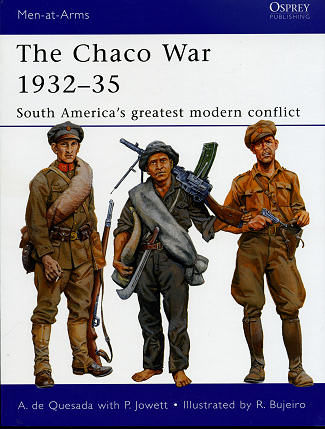
The Paraguayan Infantry I have already painted were colour wise based on this image:
It's the front cover of the Osprey as I found it on google images, the Paraguayan Infantryman being the man in the centre (if you hadn't already guessed). One thing the Osprey has inside is lots of actual photographs of soldier during the war and a number of images of Paraguayan Infantry. One such image (not in the Osprey but which emphasises my point) is:
Now I'm not sure if it's a trick of the light or camera, or if there is a point in the Osprey I haven't yet gotten to, but the majority of the images I can find of Paraguayans would lead me to believe that their uniforms are infact, at least in the majority far lighter than the cover of the Osprey would lead you to believe. One of the few images I found to the contrary was this one:
But I would still say the uniforms are a few shades lighter than the Osprey, and there's a fair few lighter shirts and trousers dotted around. So maybe it's closer to the truth to paint my troops in a much lighter yellow-green as opposed to the olive (castellan green) I was using.

Just a thought, thanks for stopping by!
WGP

Thursday, 5 February 2015

The Chaco War Project

My wargaming 'hipsterness' has reached new heights in that I'm now planning on doing a Chaco War project... a war which has fairly little information out there in the various aisles of the internet, at least information in English. So I bought my first Osprey, and through looking at pictures on google images realised I had a few relatively useful miniatures in my 'random miniatures I bought with no intention of actually using' box. A while back I grabbed a few of EM4's civil war figures, one set of Confederates and one set of Union. Browsing google I realised while not perfect there were enough similarities between Paraguayan infantry in the Chaco war and EM4's confederates that I painted some up as such. Here's how that went: 
 After a layer of PVA because the plastic is more like vinyl and Nato Black from Tamiya. I also cut the bayonet of off the end of the rifle.
 The base colours.
 A wash of Agrax Earthshade.
 Sand on the integral base.
The base was painted with Tamiya Khaki and finally the whole figure was lightly drybrushed with Ushabti Bone, a process I have heard called 'dusting'.

I'm looking at more conversions, such as turning the Union figures into Bolivian Infantry, but only time will tell on that one! I'm also looking at scratch-building some Vickers MGs so more on the Chaco War project in the future!

Thanks for stopping by!
WGP 

Wednesday, 4 February 2015

When a game is obviously a game it's a problem

If you regularly have a peek at what I'm up to you'll usually see that I'm tweaking or working on rules, in fact this is probably the main way my hobby expresses itself in my day to day life. When I'm not thinking about rules I'm usually painting models and listening to podcasts, my favourite of which is Meeples and Miniatures. The reason I love this podcast so much is because, as you may have guessed already if you've ever heard the show is how in depth they go into the rules mechanics of certain games. In the Meeples and Miniatures spin-off podcast View From the Veranda the host Neil and Henry Hyde of Miniature Wargames fame were discussing the difference between 'gaming' and 'wargaming', 'gamers' and 'wargamers'. The 'wargamer' being the one more concerned with historical plausability and realism as opposed to cool mechanics, and the 'gamer' being all about the mechanics as an end in themselves rather than a means to an end. My thoughts on this distinction came to a head while watching a demo game of Bolt Action from Warlord Games on the Beasts of War youtube channel. Bolt Action has been called by many the 40k of the historical hobby, which makes a lot of sense when you consider the minds behind it, and isn't necessarily a bad thing (although I'm sure some mean it that way). Bolt Action has at it's core a mechanic to randomise unit activations. There is a central bag of dice into which is added a die per unit on both sides. When a die is drawn a unit activates the colour of the die determining which side it belongs to. I drew a grey die so the Germans activate, next I drew a green die so the Americans activated a unit, so on and so forth, with each unit only activating once each. The problem came for me when Warren noticed that since one flank on his opponents side had already activated it wasn't urgent for him to take action on that flank. I would say it provides you with a tactical choice to make, but in reality it doesn't because the correct choice is and always will be obvious, attack what hasn't yet activated to reduce its effectiveness, but that's not my main problem. My main problem is that it presents you with a 'game' scenario, not a 'historical' scenario. When has any general ever said "It's no longer pressing for me to order my men on the right flank since the enemy has already activated his units." What the mechanic does is force something to the surface that we as wargamers really shouldn't be reminded of - that model men need to be 'activated' at all. Real soldiers don't pause after they have run a certain distance, or wait their turn to shoot, and while these may be necessary evils in many cases for us as wargamers we shouldn't be reminded of such things while playing, especially when we are reminded by making a choice that was never made by a real life officer. Call it a fatal flaw in the single unit activation type game, at least one where you determine the activations to take place as opposed to randomness like in Gruntz or levels of experience like in USE ME. The goal we are striving for as rules writers or tweakers (because if you game you're one or the other) is simultaneous action, so why make a point out of being a single unit activation style game?

Thanks for stopping by!
WGP

Saturday, 31 January 2015

How Easy it is to Adapt 'That Solo Idea' for Two Players

Roll off to determine which player gets the first turn. Each player gets the standard 10 dice. On your turn you declare your action, your opponent then declares their equivalent action. You draw a card and roll your dice. If you succeed you perform your action, if not your opponent performs theirs. It is then your opponents turn, they declare their action, you declare your equivalent, and then they draw a card and roll their dice.

Repeat this process until someone wins!

Thanks for stopping by!
WGP

Thursday, 29 January 2015

More Playtesting of That Solo Idea and Thoughts

So I played another game again today with similar forces. Sir Gildain his Squire Pharen and their wizard friend Tannik faced off against Lord Urleth and his Zombies. It did not go well for Sir Gildain and his companions. Sir Gildain faced off against a Zombie in the middle of the field and was soon overwhelmed by more arriving and the infamous Lord Urleth. Pharen managed to reach Gildain slaying a Zombie on the way but more soon arrived. Finally Tannik got moving and attempted something drastic, he tried to pull a tree up from its roots and cause it to fall on a Zombie to free up Gildain's withdrawl. Unfortunately it fell on Gildain knocking him unconscious. Pharen then lunged desperately at Urleth hoping to dissuade him, but was knocked flat, and like his liege was out of the fight. Urleth then leapt the fallen tree as Tannik retreated to a ruined house to make his final stand. Tannik attempted a risky spell, casting an arc of energy to shoot Urleth from his horse and out of the battle. However Urleth's apparent magical resistance again came into play. The arc reflected from his black armour and struck Tannik. The day was lost, and once again the vile necromancer Urleth escaped.

I had a lot of fun with the game, and realised the openness of the system really opens things up, especially for those magic characters. All I had to declare was what Tannik wanted to use his magic to do, and then an equivalent - no spell list needed, no long list of points values and the system automatically balances itself.

The card system also really came into its own. The reason things went south so quickly was because I knew I only had a few cards remaining in the deck and if I hadn't taken out Urleth by the time they were gone he would automatically escape, this pushed me to make rash decisions, and it didn't help that at the time I was running low on dice!

I need to play with more ranged characters that aren't mages though. the challenge of thinking of an equivalent action when not using something as chaotic as magic should be interesting. A crossbow will either hit or miss, it's not likely to deflect and hit the firer!

Thanks for stopping by!
WGP